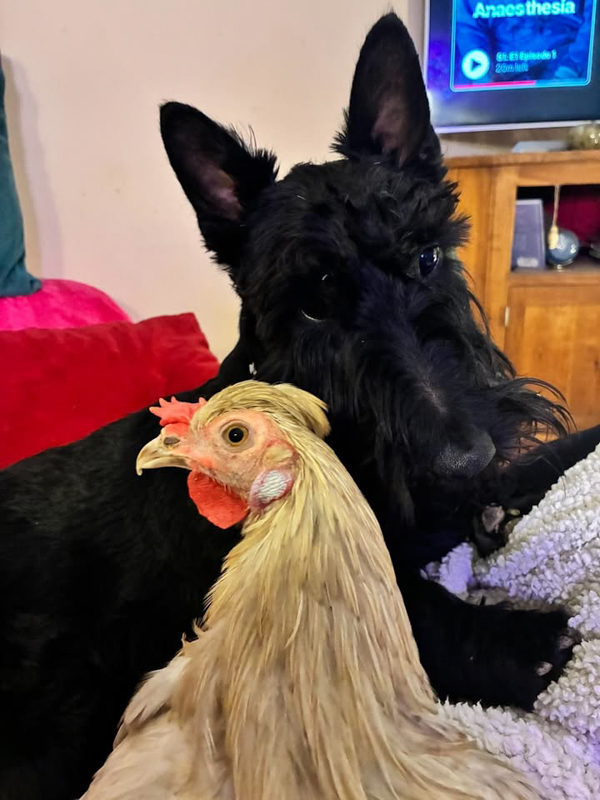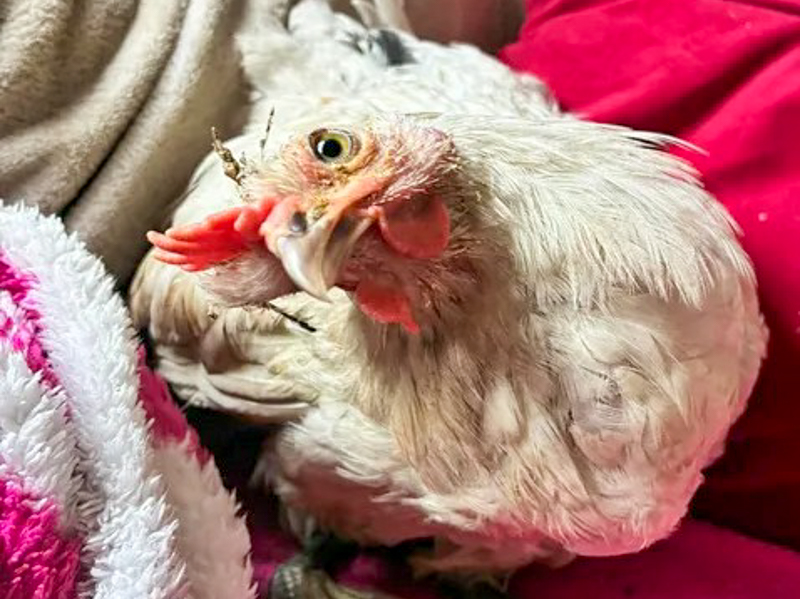
We love a challenge and certainly wouldn’t want to chicken out!
One of the distinctive features of our practice that clients love to hear about is our rehabilitation and hydrotherapy services, typically treating our canine companions and the occasional co-operative cat! However we’ve had an unusual patient recently, Shakira the Silky chicken!
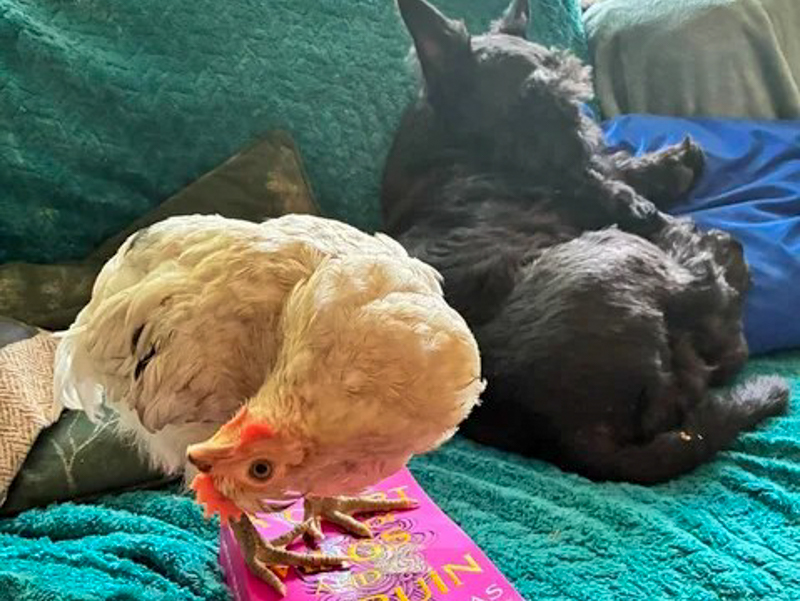
Shakira’s mum got in touch with us in the summer after rescuing her at 3 months old. Straight away it was obvious that Shakira was uncomfortable in her neck and was unable to hold her head correctly. She brought her down to the practice to see head vet Sarah who diagnosed Shakira with torticollis, otherwise known as ‘wry neck’. Torticollis can occur in chickens for a variety of reasons such as nutritional deficits or acute head/neck trauma. This can result in the chicken suffering mobility and coordination issues which can limit their ability to walk, eat and drink.
As you can see in the photo above Shakira’s head was all twisted and she gazed upwards.
We all know Sarah is a passionate rehomer for the British Hen Welfare Trust so she was very keen to give Shakira the best chance of recovery. She recommended introducing Vitamin E and selenium supplements into Shakira’s diet. These nutrients are essential for a chicken’s growth and development, helping to support neurological and muscular health as well as increasing stress resistance and immunity. She also advised trialling a course of laser treatment and referred Shakira to the rehab department for a physiotherapy assessment.
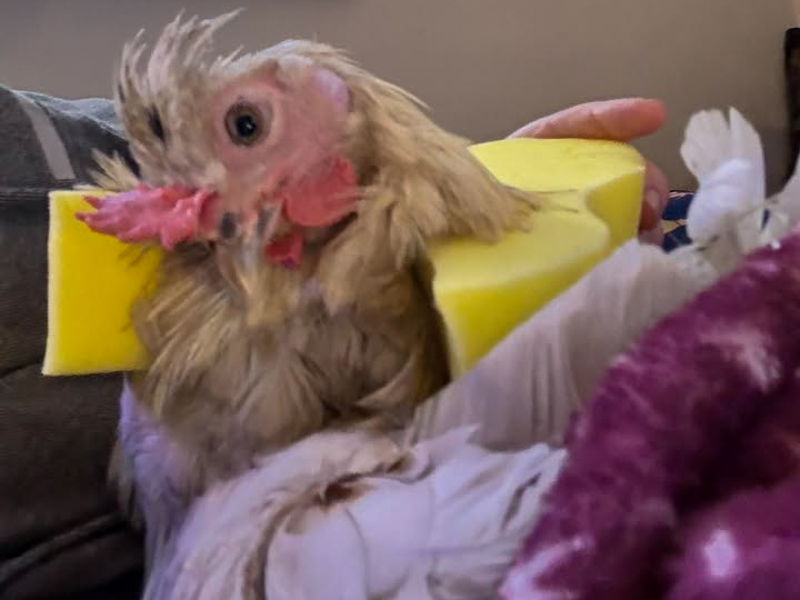
Low-level laser therapy uses infrared light to boost cellular metabolism to promote healthy tissue function. In Shakira’s case it was used to reduce neck stiffness and discomfort alongside a basic exercise plan. Since Shakira was struggling to hold her head upright due to significant torsion through her neck, we advised to use a makeshift brace made out of a sponge to give her some support and stability. This helped to re-educate muscle function and align her joints. Shakira is a very food motivated bird so we used food to encourage independent neck movements to stretch and lengthen the contracted tissue before helping to strengthen the sides equally.
Our advice also consisted of adjusting her food and water bowls as well as providing opportunities for her to ‘perch’ on poles to strengthen the muscles in her legs and feet.
Despite our goals of rehabilitation, scientific-based evidence for chickens is very limited so Shakira’s outcome was unknown. Her mum knew her quality of life would be restricted if she didn’t show signs of improvement within a few months. We’re pleased to say that she has had a breakthrough in her condition since her mum sent us this update a few weeks ago:
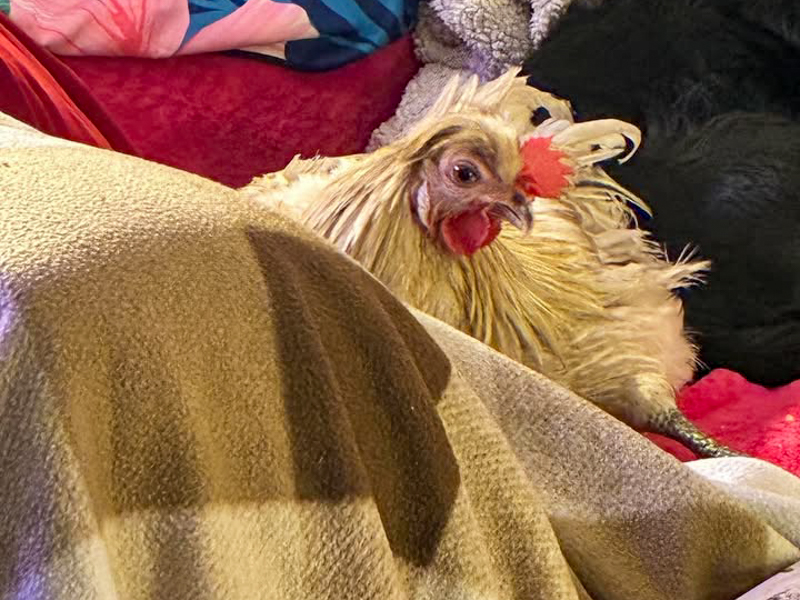
“Hello! Just thought I’d send a little update on Shakira and over the past 10 days there’s been a drastic improvement in her neck, and it’s now mainly upright! Before it was only really upright when eating so it’s a big change. She seems excited by this and has started moving forwards, as before she was only moving backwards. She’s on her haunches doing this and her legs are very splayed (she looks like she’s ice skating!) but it’s remarkable progress and far more than I’d imagined possible. I carried on with the vitamins as you recommended and the neck strengthening physio exercises and all of a sudden Shakira has a lot more quality of life. This is her this evening: she can’t stop moving atm! Thank you so much to you and your lovely staff for all your advice and care and the laser therapy sessions. That was so generous. Hope to see you soon!”
We absolutely love to hear feedback from our clients and having this message through is what makes working in the veterinary industry so fulfilling. Shakira has a new chance at a full life thanks to the knowledge of the team and getting creative when we don’t have a standard protocol to work from. We also need to credit the commitment of Shakira’s mum towards giving her a second chance and the best care a chicken could ask for!